What happened
Based on Cao Zhi’s poetic rhapsody, the scroll tells of a mortal and a goddess who meet, fall in love, and must separate. Unrolling it advances their story.

Wikimedia Commons / The Palace Museum · Public Domain · Artwork details appear later
A moment for the eye to rest

Nymph of the Luo River · The details can wait a little longer
FEEL
UNDERSTAND
Digital image: Wikimedia Commons / The Palace Museum · Public Domain · commercial use permitted · View source ↗
Drag or swipe sideways to unfold the scroll.


Based on Cao Zhi’s poetic rhapsody, the scroll tells of a mortal and a goddess who meet, fall in love, and must separate. Unrolling it advances their story.
Rocks, trees, and shores form a continuous landscape. Repeated figures let several moments inhabit one pictorial field.
There is no single instant of illumination. The warm silk ground holds every scene in something like remembered time.
Mineral pigments and fine lines work softly together; bright figures become narrative markers across broad land and water.
This Song copy preserves a composition associated with Gu Kaizhi and an early Chinese way of organizing time through the handscroll.
Beyond its love story, it makes viewing resemble walking: time appears only as the scroll is opened section by section.
What did it leave with you?
Where next · WHERE TO
Not more of the same—just three possible paths.
Stay nearby · goddess

Sandro Botticelli · circa 1485
Move from a riverbank encounter to an arrival from the sea
Go farther · narrative

Hieronymus Bosch · c. 1490–1510
See another image where many moments happen together
Change direction · distance
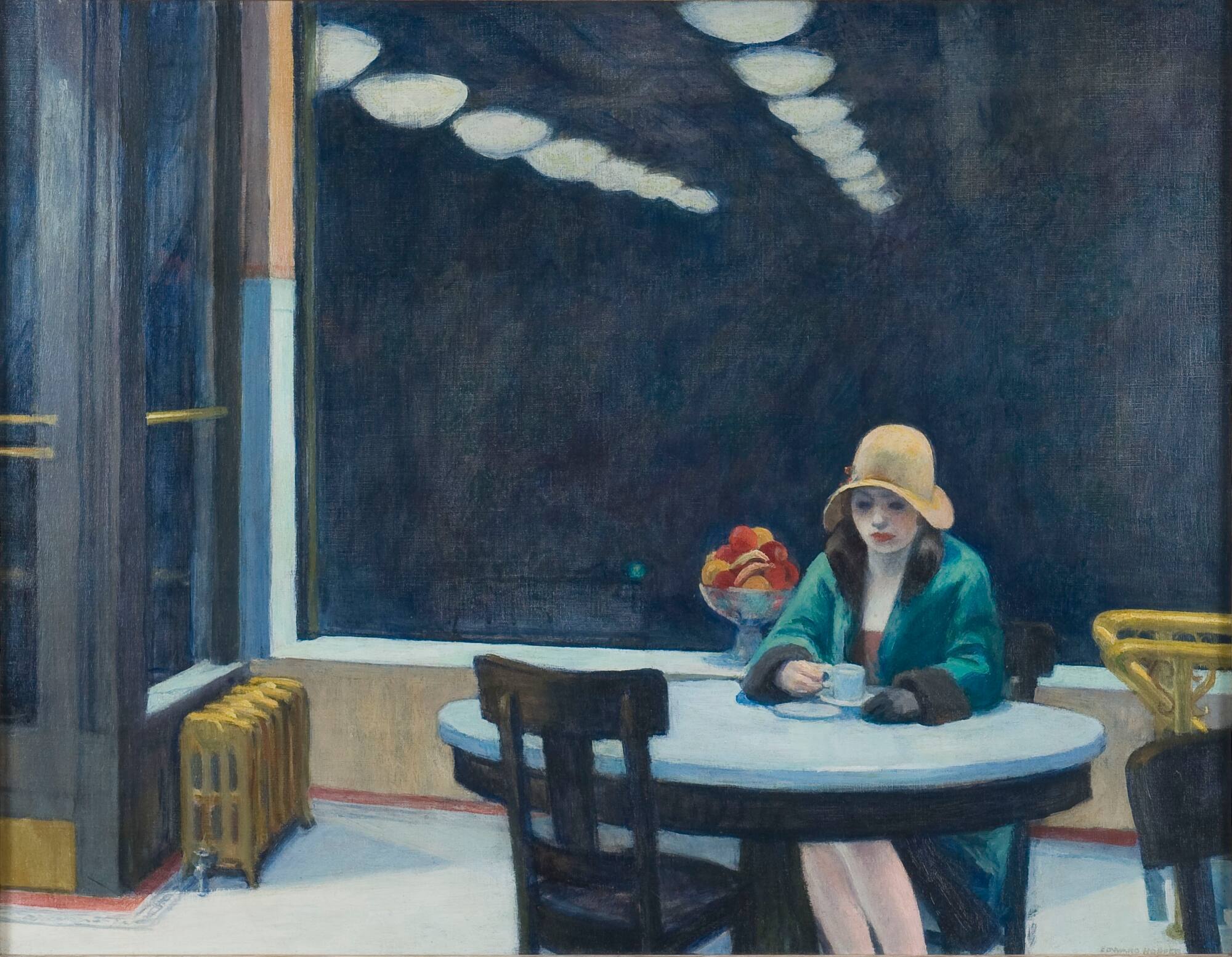
Edward Hopper · 1927
Return from mythic parting to an empty chair in a modern city